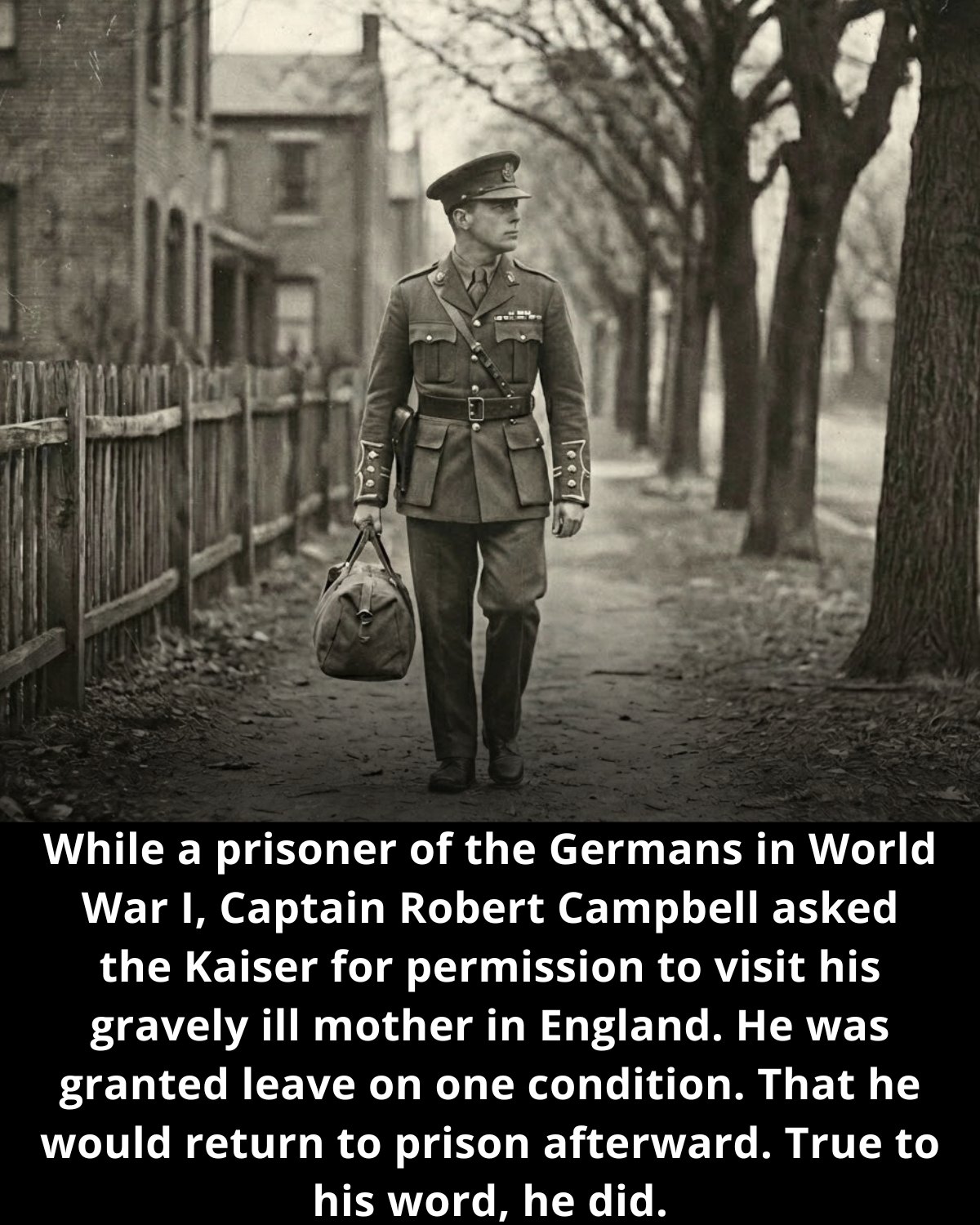
During World War I, British officer Robert Campbell found himself a prisoner of the Germans after being captured in 1914. Like thousands of other officers, he was sent to a POW camp in Germany, where daily life was marked by uncertainty and long stretches of waiting. News from home arrived slowly, and for Campbell, one message carried devastating weight. His mother in England was gravely ill and not expected to recover.
Instead of attempting escape or accepting the situation, Campbell made an unusual request. He wrote directly to Kaiser Wilhelm II, asking for permission to travel to England to see his dying mother. The request was extraordinary, and even more so was the response. The Kaiser agreed, on one strict condition. Campbell had to give his word as an officer that he would return to German captivity once his visit was over.
Campbell traveled to England, spent time with his mother before her condition worsened, and then did exactly what he had promised. He returned voluntarily to Germany and resumed his life as a prisoner of war. His action stunned both sides and became one of the most cited examples of honor during the conflict. In a war defined by betrayal, propaganda, and mass destruction, Campbell’s quiet decision stood as proof that personal integrity still carried weight, even behind barbed wire.